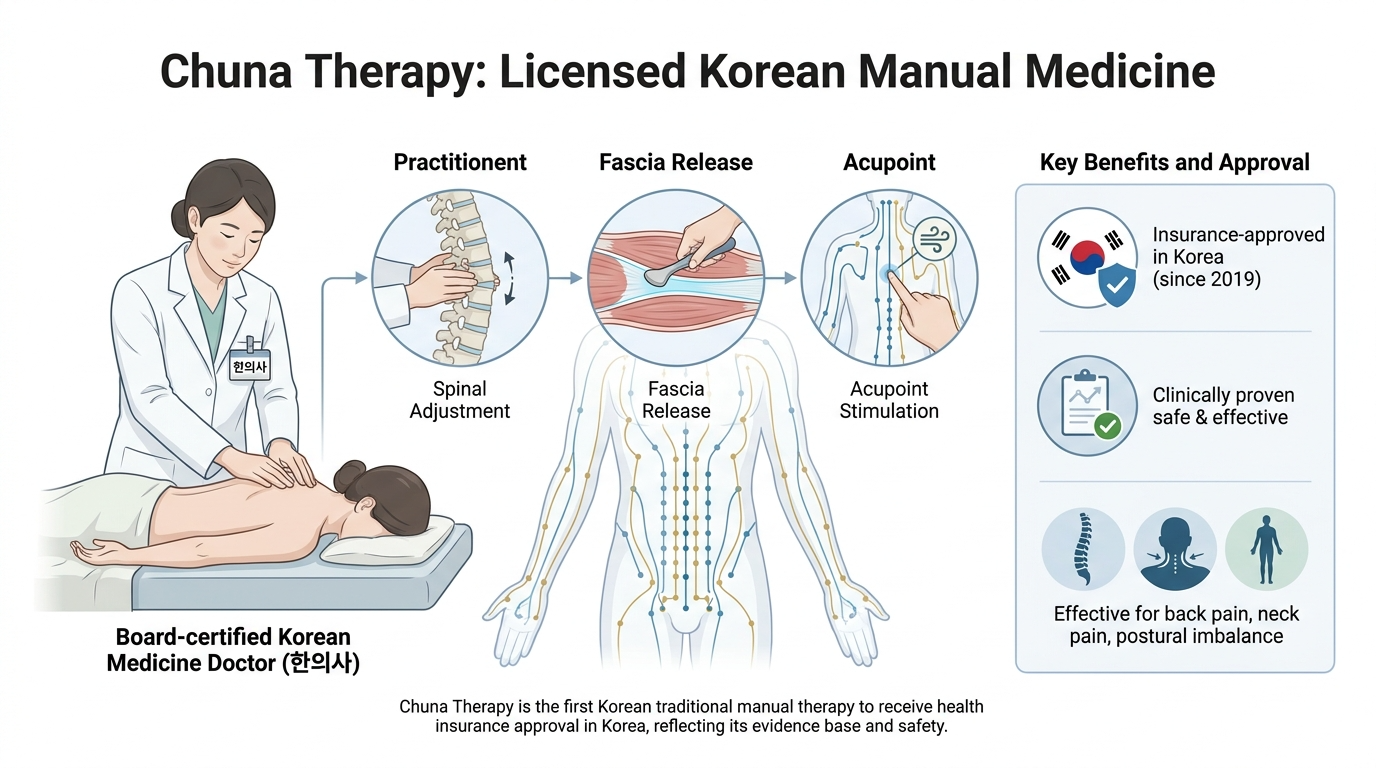
What Is the Chuna Therapy (추나요법)?
Chuna Therapy is a licensed Korean traditional medicine manual therapy performed exclusively by board-certified Korean Medicine doctors (한의사). It combines spinal adjustment, fascia release, and acupoint stimulation — similar in principle to chiropractic and osteopathic manipulation, but rooted in the meridian and Qi framework of traditional East Asian medicine.
In 2019, Chuna became the first Korean traditional manual therapy to receive official health insurance coverage in Korea — reflecting its clinical evidence base and safety profile.
- Licensed Korean Medicine practitioner (한의사)
- Spinal adjustment + fascia release + acupoint stimulation
- Insurance-approved in Korea since 2019
- Effective for back pain, neck pain, and postural imbalance
What's Included in the Chuna Therapy Session?
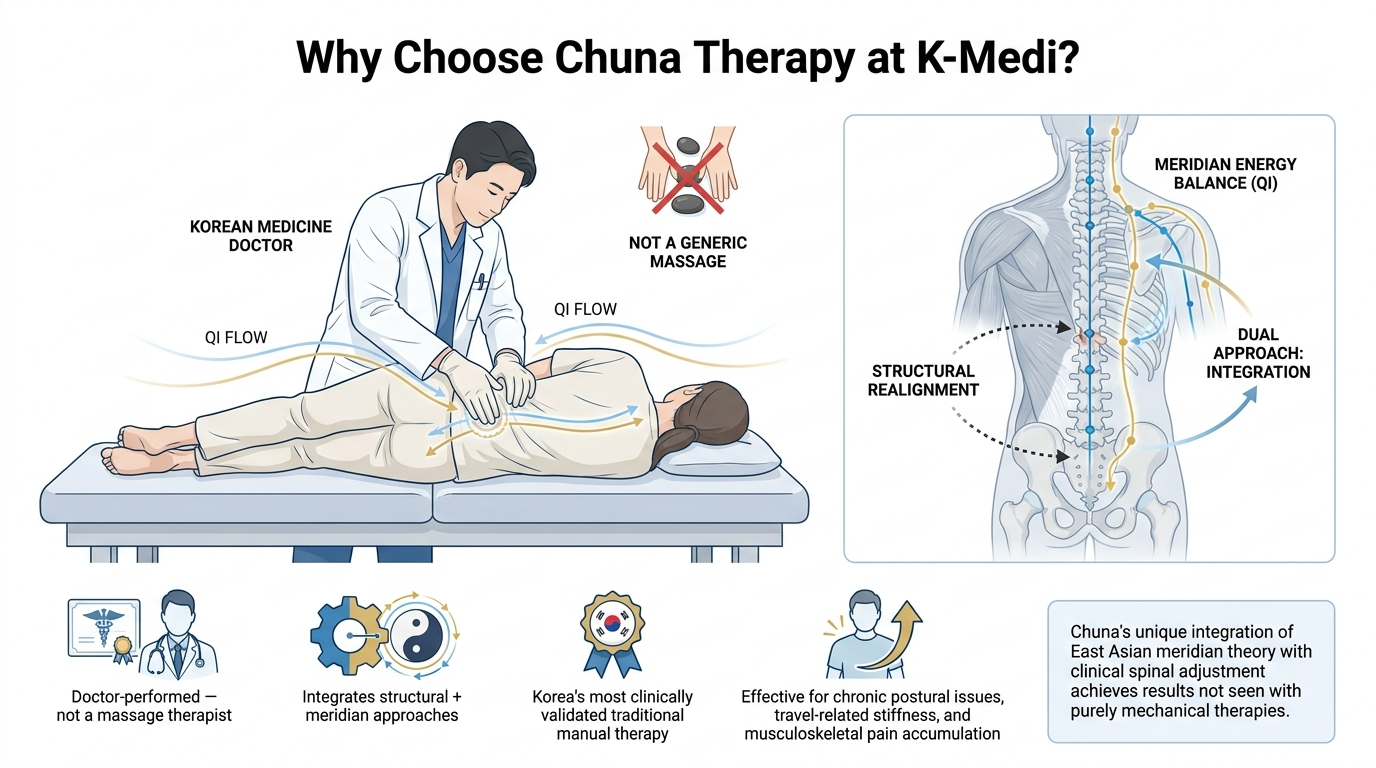
Why Choose Chuna Therapy at K-Medi?
Chuna is not generic massage — it is a structured manipulative therapy performed by a licensed Korean Medicine doctor trained specifically in spinal and musculoskeletal medicine. The integration of meridian theory with structural adjustment produces effects on both the musculoskeletal system and the broader energy balance (Qi flow) that purely mechanical approaches do not address. It is particularly effective for chronic postural issues, travel-related stiffness, and musculoskeletal pain accumulation.
- Doctor-performed — not a massage therapist
- Integrates structural + meridian approaches
- Korea's most clinically validated traditional manual therapy
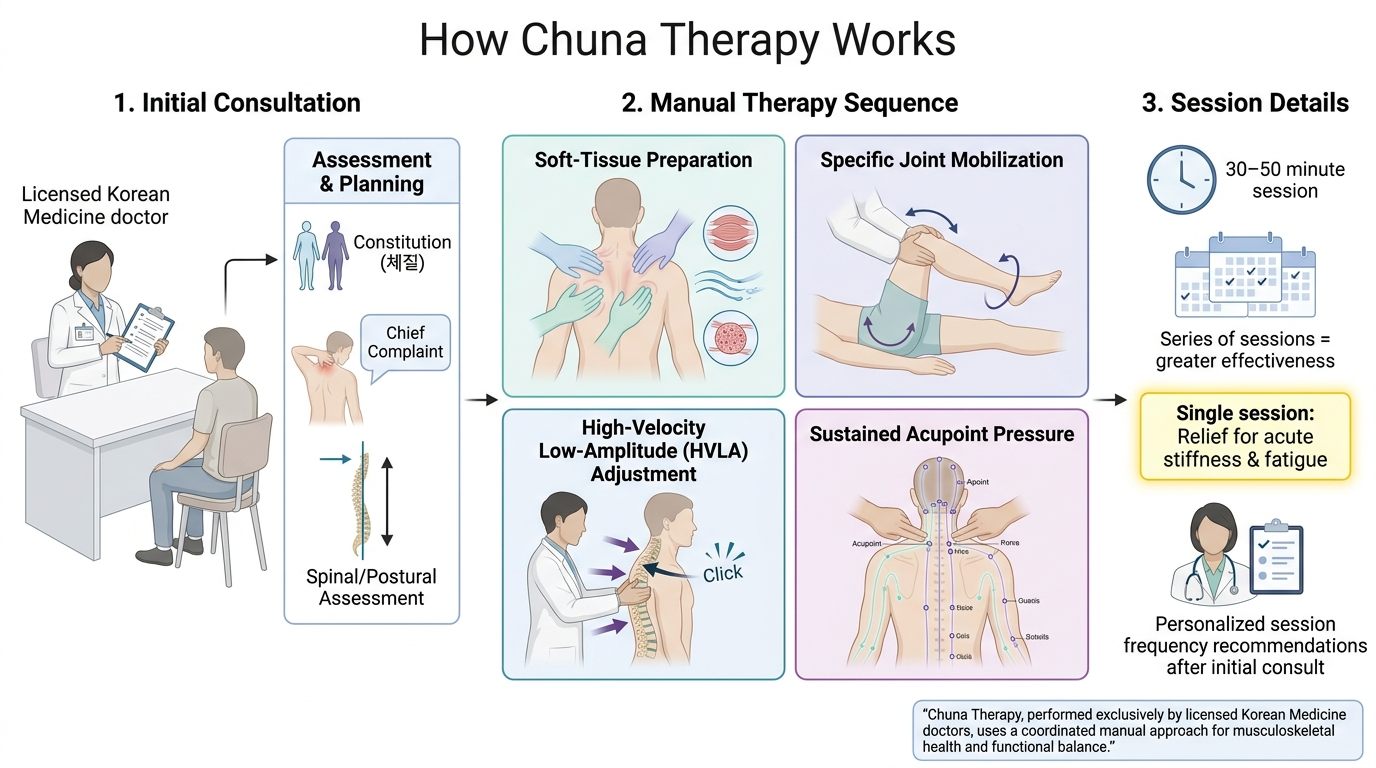
How Chuna Therapy Works
The session begins with a Korean Medicine doctor consultation assessing your constitution (체질), chief complaint, and spinal/postural condition. The practitioner then applies a sequence of manual techniques — including soft-tissue preparation, specific joint mobilizations, high-velocity low-amplitude adjustments where indicated, and sustained acupoint pressure — in a coordinated treatment plan.
Each session lasts 30–50 minutes. A series of sessions is typically more effective than a single treatment, but even single-session results for acute stiffness and travel fatigue are notable. The doctor will recommend optimal session frequency after the initial assessment.