My Consultation Cart

No services selected yet.

Korean Medicine
Korean Traditional Medicine

Meridian acupuncture stimulating endorphin release and circulation for targeted healing.

Korean Traditional Medicineに戻る
間隔
40分
麻酔
なし
痛みのレベル
軽度
頻度
単回

What Is the Korean Constitutional Acupuncture?

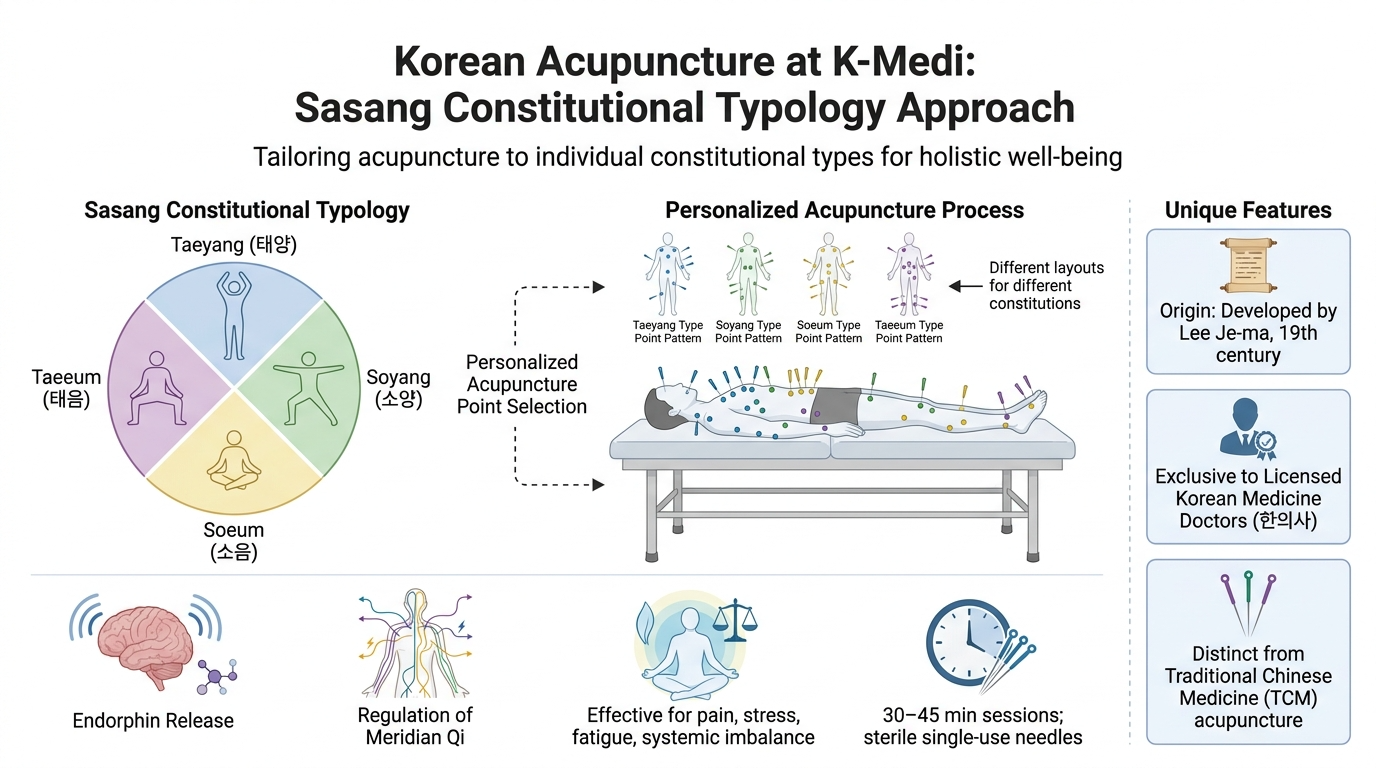
Korean Acupuncture at K-Medi uses Sasang constitutional typology — a uniquely Korean system that classifies individuals into four constitutional types (Taeyang, Taeeum, Soyang, Soeum) and tailors acupuncture point selection specifically to the individual's constitution, not just the presenting symptom.

This constitution-based approach, developed by Korean physician Lee Je-ma in the 19th century, is distinct from standard TCM acupuncture and is practiced exclusively by licensed Korean Medicine doctors (한의사).

  • Sasang constitutional diagnosis (사상의학)
  • Endorphin release and meridian Qi regulation
  • Effective for pain, stress, fatigue, and systemic imbalance
  • 30–45 minute sessions with sterile single-use needles
Korean Constitutional Acupuncture

What's Included in the Acupuncture Session?

Constitutional Assessment
Sasang typology diagnosis before treatment
Acupuncture Treatment
20–40 minute needle retention at selected points
Moxibustion (Optional)
Warming moxa at selected acupoints if indicated
Post-Treatment Guidance
Lifestyle and dietary advice per constitution

Why Choose Korean Acupuncture at K-Medi?

Constitutional acupuncture goes beyond symptom treatment — it addresses the underlying imbalance specific to your constitutional type, producing more targeted and sustained results than generic point selection. The Sasang system's 150+ years of clinical refinement and its integration into Korean national healthcare as a covered treatment reflects a level of clinical validation rare in traditional medicine systems.

  • Constitution-specific — not generic symptom treatment
  • Practiced by licensed Korean Medicine doctors only
  • Covered by Korean national health insurance — clinically validated
Korean Acupuncture

How Korean Constitutional Acupuncture Works

The session begins with constitutional assessment — the doctor evaluates your body type, complexion, voice, and primary health tendencies to determine your Sasang constitution. This informs which meridians and points will be most beneficial for your specific physiology.

Ultra-fine sterile single-use needles are then inserted at selected acupoints. Most patients feel minimal sensation — a brief prick followed by a dull ache, warmth, or electrical sensation (De Qi response) indicating Qi activation. Needles are retained for 20–40 minutes as you rest. Moxibustion (warming dried mugwort at acupoints) may be added if indicated by the constitution.

Korean Constitutional Acupuncture

Who Is This Treatment For?

Chronic Pain
Musculoskeletal pain, headache, and neuropathic pain conditions
Stress & Fatigue
Burnout, insomnia, anxiety, and chronic fatigue syndrome
Systemic Imbalance
Digestive disorders, immune dysregulation, and hormonal imbalance

Frequently Asked Questions

Most patients find acupuncture to be a comfortable or even deeply relaxing experience. The needles used are ultra-fine — far thinner than injection needles. Initial insertion may produce a brief prick sensation, followed by the De Qi response (dull, heavy, or warm sensation) which indicates correct needle placement.

Acute conditions often respond within 3–5 sessions. Chronic conditions benefit from a longer series of 8–12 sessions. Many medical tourists book 2–3 sessions during their stay and continue with a local practitioner at home.

Strongest evidence exists for musculoskeletal pain (back pain, neck pain, osteoarthritis), headache and migraine, chemotherapy-induced nausea, and post-operative pain. Korean constitutional acupuncture also has strong traditional clinical evidence for digestive disorders, fatigue, and stress-related conditions.

Have more questions? Our coordinators are happy to help.

Free Consultation WhatsApp Us
から
$80~
無料相談